

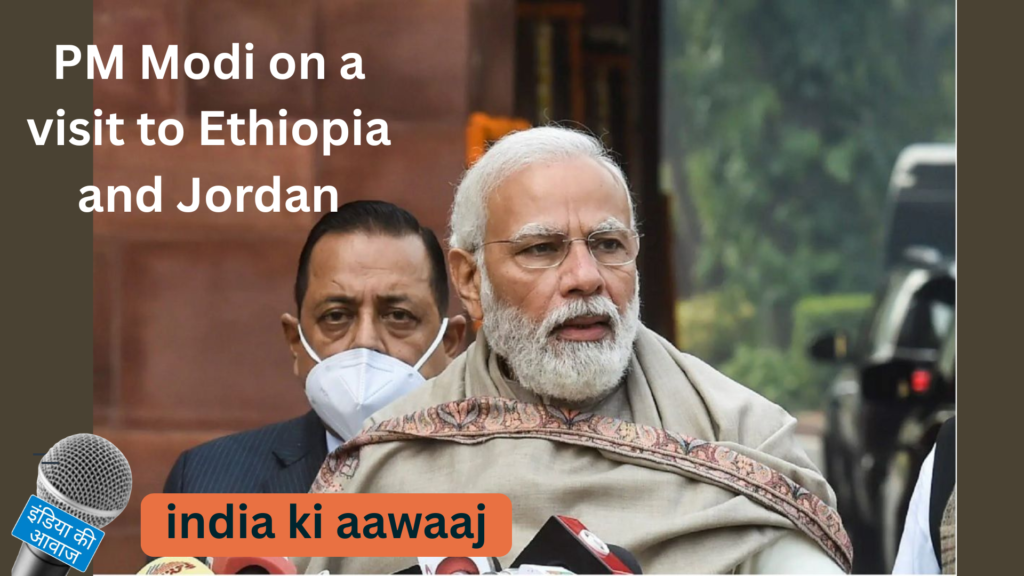
PM Modi’s Visit to Ethiopia and Jordan: The Strategic Significance of India’s Three-Nation Mission
Prime Minister Narendra Modi’s visit to Ethiopia and Jordan is a significant chapter in India’s proactive, multi-faceted, and forward-looking foreign policy. This visit is part of India’s three-nation mission, the primary objective of which is to further strengthen India’s strategic, economic, diplomatic, and cultural presence in Africa and West Asia. Amidst the rapidly changing global geopolitical landscape, this mission is considered a decisive step towards advancing India’s long-term national interests.
The Three-Nation Mission: A Comprehensive Approach
The Prime Minister’s mission is not merely a formal diplomatic visit, but an attempt to put into practice the principles of India’s “Global South” policy, a multipolar world order, and strategic autonomy. Countries like Ethiopia and Jordan are geographically, politically, and culturally significant, and strong partnerships with them can establish India as an influential power in the Africa-Middle East-Europe corridor.
Ethiopia: India’s Strategic Presence in Africa
- The Hub of the African Union
Addis Ababa, the capital of Ethiopia, is considered the diplomatic capital of Africa because it houses the headquarters of the African Union (AU). Prime Minister Modi’s visit to Ethiopia provides an opportunity to strengthen India-Africa relations at the institutional and strategic levels. This visit reinforces India’s policy of viewing Africa not merely as a resource-based partner, but as an equal development partner.
- Economic and Development Cooperation
Ethiopia is one of Africa’s emerging economies. India seeks to enhance cooperation in areas such as:
Infrastructure development,
Pharmaceuticals and healthcare,
IT and digital public infrastructure,
Agriculture and food security.
The presence of Indian companies in Ethiopia contributes to job creation and local capacity building, exemplifying India’s “win-win” diplomacy. 3. The Voice of the Global South
India has consistently advocated for strengthening the voice of the Global South at the G20 and other global forums. Closer ties with countries like Ethiopia allow India to provide more effective leadership on issues affecting developing nations—such as climate justice, debt relief, and technology transfer.
Jordan: A Partner for Balance and Stability in West Asia
- Geopolitical Significance
Jordan is a country in West Asia known for its political stability, balanced foreign policy, and peace efforts. For India, Jordan is a crucial partner in:
the Middle East peace process,
counter-terrorism cooperation,
and regional stability.
- Security and Defense Cooperation
Defense cooperation, military training, and intelligence sharing between India and Jordan are continuously expanding. Both countries share common interests in combating terrorism, extremism, and cyber threats. The Prime Minister’s visit can provide new impetus to institutional cooperation in these areas.
- Energy and Trade
West Asia is extremely important for India’s energy security. Cooperation with Jordan can open up new opportunities in areas such as:
energy diversification,
green energy,
logistics and connectivity.
Furthermore, the Indian diaspora and cultural exchanges are also strong pillars of bilateral relations.
The Three-Nation Mission and India’s Global Strategy
- India in a Multipolar World
This visit clearly demonstrates that India is not dependent on any single power bloc. Active diplomacy in Africa and West Asia provides India with:
expanded strategic options,
diversified supply chains,
and greater influence in global decision-making.
- Expansion of Economic Diplomacy
Economic diplomacy is a key pillar of India’s foreign policy under Prime Minister Modi’s leadership. Investment, trade, technological cooperation, and development partnerships are all being pursued under a coordinated strategy.
- Cultural and Soft Power
India’s civilizational heritage, yoga, education, and people-to-people ties are further strengthened through these visits. This expands India’s soft power globally.
Conclusion
Prime Minister Narendra Modi’s visits to Ethiopia and Jordan are a crucial phase of India’s three-nation mission, advancing the country’s strategic interests in a multifaceted way. These visits not only inject new energy into bilateral relations but also establish India as a reliable, balanced, and long-term partner in Africa and West Asia. In the evolving global order, such missions play a decisive role in positioning India as a responsible global power.