

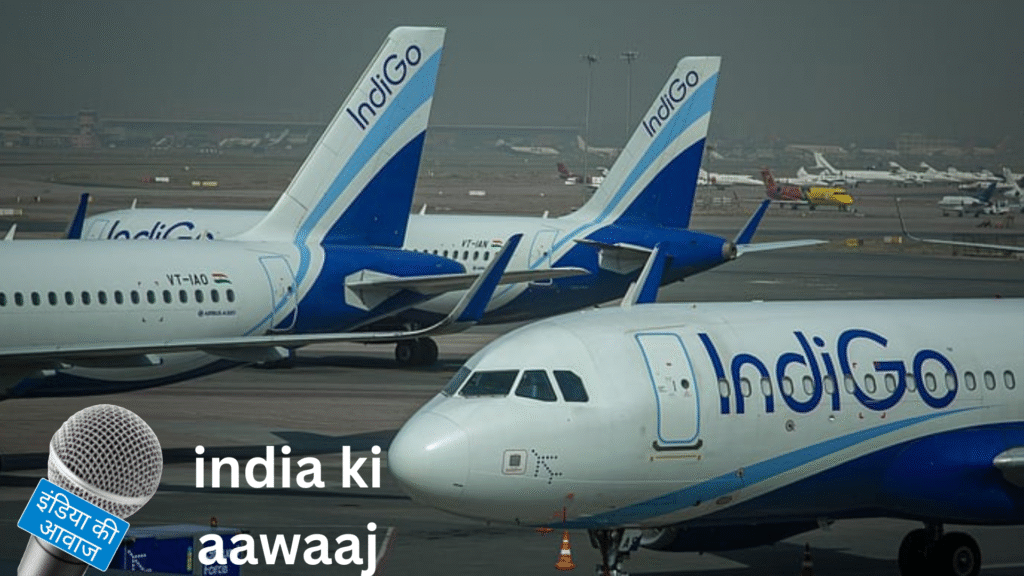
IndiGo Flights Cut by 10% — The government has ordered IndiGo to reduce its flights by 10% to provide relief to passengers from recent flight cancellations and delays.
Government Orders 10% Cut — What Happened?
In recent days, a large number of flight cancellations, delays, and passenger inconvenience complaints had surfaced across the country. Amidst this, on Tuesday (December 9, 2025), the Ministry of Civil Aviation (MoCA) directed IndiGo to reduce its total flights by 10 percent.
Before this order, the DGCA (Directorate General of Civil Aviation) had initially directed a 5% reduction on the same day, but that measure was deemed insufficient. Consequently, the reduction was doubled to 10%.
The government justified this step by stating that it was necessary to “stabilize operations — to prevent continuous cancellations and delays.” During a review of this decision, R. Mohan Naidu, the Minister of Civil Aviation, summoned IndiGo CEO Pieter Elbers to the ministry.
What does the cut mean? — How many flights will be affected per week?
IndiGo operates approximately 2,300 flights daily. A 10% reduction means the temporary suspension of about 230 flights per day.
The government has ordered IndiGo to finalize its new (revised) schedule quickly and submit it to the regulator — the DGCA.
According to several reports, the cuts have been implemented primarily on routes with high flight frequency — to reduce the imbalance between demand and supply.
Background: Why was this drastic step necessary?
In the past few days, IndiGo flights experienced widespread cancellations and delays in dozens of cities, including the capital Delhi, Bengaluru, Mumbai, Chennai, Hyderabad, Lucknow, etc.
The reason cited is that the airline showed shortcomings in its crew roster (pilot and crew) and schedule management — specifically, in adhering to the new crew rest/duty regulations. Many passengers complained that flights were being canceled despite tickets being booked, baggage was being lost, and adequate information and arrangements for refunds or alternatives were not being provided. Passengers faced significant inconvenience in these situations.
The government decided that immediate action was necessary to restore quality and reliability – and the 10% reduction is an attempt to minimize the possibility of disruptions (overbooking/overcrowding/operational instability).
Affected parties – Passengers, other airlines, and IndiGo
For Passengers
- Fewer flights mean that the number of seats available each day will decrease – if demand remains the same, getting tickets might become difficult.
- However, the government and the airline have stated that IndiGo will continue to operate flights on all its previous routes (cities). ([India Today][6])
- The refund process for canceled flights has been completed, and instructions have been given to complete the remaining baggage handover and refund processes soon.
- Travelers will need to pay attention to changing schedules, seat availability, and prices – especially during peak demand periods.
Opportunities for other airlines
The government has indicated that IndiGo’s reduced route slots may be allocated to other air operators – giving them the opportunity to operate additional flights.
This means that other airlines – whether large or small – can increase their services to meet the increased passenger demand.
For IndiGo – an operational and reputational setback
- The 10% schedule reduction means that IndiGo’s daily flying capacity will decrease – which could impact its market share and revenue.
- This is a major publicly announced action that has put IndiGo’s credibility at risk.
- IndiGo will have to undergo monthly schedule reviews with the DGCA and the Ministry, and it remains to be seen whether they can maintain stability with the new schedule or if further cuts will be necessary. Government and Regulator’s Intent: The Goal is Not Just Reduction, but Stability + Trust
The government’s objective is not merely to reduce flights, but to ensure that passengers receive a reliable air travel experience. The ministry summoned a high-level review meeting and sought answers from IndiGo’s top management – this indicates that the problem is being taken seriously.
The minister stated that the reductions will reduce operational pressure, allow for better crew management, decrease cancellations, and minimize passenger inconvenience.
Furthermore, the indication of providing space to other airlines shows that the government wants to ensure healthy competition and backup capacity in the domestic aviation market.
Challenges and the Way Forward
While the reduction is an immediate solution, it may also present several challenges:
- If demand remains high – such as during holidays, festivals, or peak travel seasons – it could lead to seat shortages or increased ticket prices.
- It is not yet clear how quickly other airlines will receive slots and how many flights they will be able to operate – if they cannot add sufficient capacity, passengers may still face inconvenience.
- Restoring passenger confidence will not be easy – after major cancellations, people will book tickets more cautiously in the future.
- The regulator and the ministry will have to ensure that IndiGo or other airlines do not again overload their flight schedules to the point where the situation deteriorates again.
- In conclusion, India’s leading airline, IndiGo, is currently going through the biggest operational crisis in its history. Following passenger hardships, mass cancellations, and delays, the government has taken decisive action, ordering a reduction of up to 10% in total flights. This move is not only a strong message to the airlines but also an attempt to restructure the domestic aviation system to ensure stability, reliability, and passenger safety and convenience. If IndiGo and other airlines operate in a disciplined manner with the new schedule, this crisis will serve as a cautionary tale for the future, and passengers will receive better and more reliable service. Nevertheless, passengers, airlines, and regulators must all remain vigilant: checking the status before future travel, verifying seat availability, and making it a habit to seek immediate information about any changes or disruptions.