
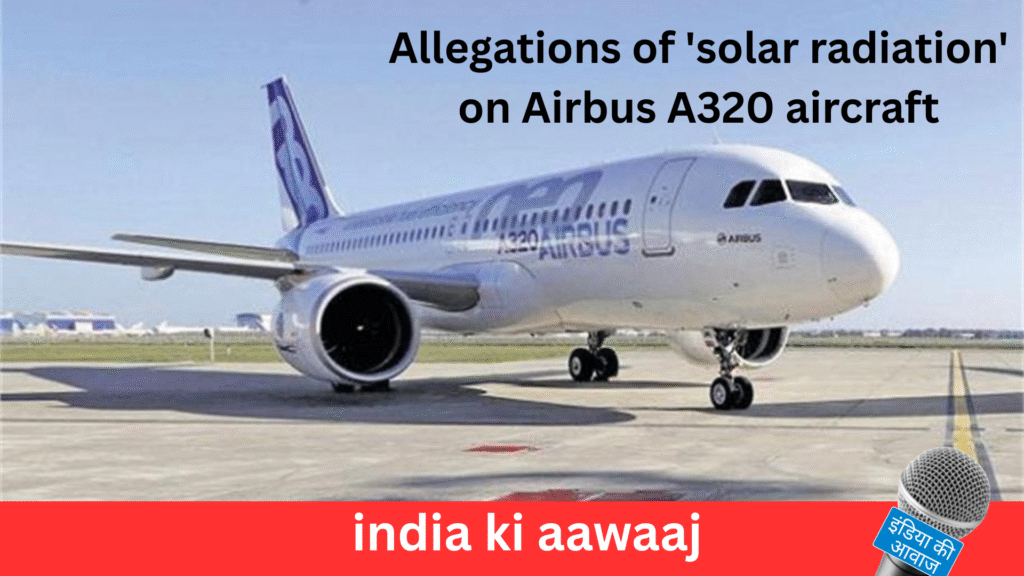
Allegations of ‘Solar Radiation’ on Airbus A320 Aircraft – Affecting Nearly 350 Flights in India
A shocking news has recently emerged: flight-control data on Airbus A320 family aircraft has been found to be potentially affected by ‘solar radiation’.
Given the severity of this issue, Airbus has issued emergency software/hardware updates for its A320-flat-body family (A320, A321, A319, etc.) aircraft worldwide.
India, which has a large fleet of A320 family aircraft, has been directly affected by this issue—several A320 aircraft in the country have had to be temporarily grounded.
Solar Radiation – What is the Problem?
- The problem originated from an incident in which very high solar particle/radiation activity on an A320 aircraft corrupted flight control data.
- Flight-control systems, such as the Elevator Aileron Computer (ELAC)—which operates aircraft control panels (wings, elevators, etc.)—are extremely sensitive.
According to Airbus, the intensity of this solar radiation was sufficient to cause data corruption, potentially impacting the aircraft’s stability and control.
In light of this risk, Airbus has decided to require affected aircraft to undergo software updates or, if necessary, hardware replacement before they can fly.
Situation in India—Affected Aircraft and Airlines
- Major airlines operating A320-family aircraft in India: IndiGo, Air India, and Air India Express.
- It is estimated that 200–250 aircraft of these airlines in India require software changes.
- According to some reports, a total of over 350 aircraft (A320-family) have been grounded to implement the necessary updates.
- The total fleet size of major airline operators in India is reported to be around 560 A320-family aircraft.
Impact on Flights – Delays, Cancellations, and Inconveniences
- Due to software/hardware updates, several aircraft have been temporarily grounded.
- This is likely to cause flight delays, and some flights may even be cancelled.
Airlines have requested passengers to regularly check their flight status (app or website).
- However, Airbus states that software updates can be implemented for most aircraft within a few hours—but older aircraft (approximately 1,000 globally) with hardware updates will take longer.
- Bharti Airlines states that it is implementing procedural updates immediately, but operations and schedules are still being impacted.
International Context—This Is Not Just an Indian Problem
- Airbus has stated that this problem is not limited to India. Globally, approximately 6,000 A320-family aircraft could be affected—potentially causing widespread disruption to pedestrians and flights worldwide.
- Several European and other international airlines have warned of flight cancellations or schedule changes.
- The reason behind this is that solar activity (solar storms/high-energy solar radiation)—which can sometimes be very intense—can pose a threat to the electronics and software systems of modern aircraft. This issue is critical for both aviation safety and future planning.
Implications for Safety and the Aviation Industry
- This incident demonstrates that as the dependence on software and electronic systems in modern aircraft increases, the impact of natural hazards like solar activity can become even more severe.
- Airbus and other aircraft manufacturers will now have to pay special attention to the design and software architecture of their aircraft in the future—to protect against solar radiation.
- Airlines must also establish emergency update mechanisms to respond promptly to similar incidents in the future.
- Passengers and airports must also be alerted that flight delays or cancellations are possible—especially during large-scale fleet updates.
Current Efforts and Improvements
- Airbus has issued an “Alert Operators Transmission” (AOT) and then an emergency “Emergency Airworthiness Directive” for the affected aircraft.
- In India, IndiGo and Air India (among other airlines) have stated that they are immediately implementing the proposed updates so that the aircraft can return to flight as soon as possible.
- Airbus has clarified that safety is its top priority, and it has taken this step to ensure the safety of passengers and flight crew.
Conclusion
The Airbus A320—one of the world’s most popular single-aisle aircraft—has experienced an unexpected but serious vulnerability. Solar radiation could have corrupted flight-control data, potentially impacting aircraft safety and operations. In response to this threat, Airbus has ordered immediate software/hardware updates globally.
In India, where A320-family aircraft are widely used, approximately 200–350 aircraft have been temporarily grounded. This may have caused delays and inconvenience to passengers; however, airlines and the aircraft manufacturer have taken steps to resolve the issue quickly.
This incident is not only significant from an aviation safety perspective, but it also demonstrates that