

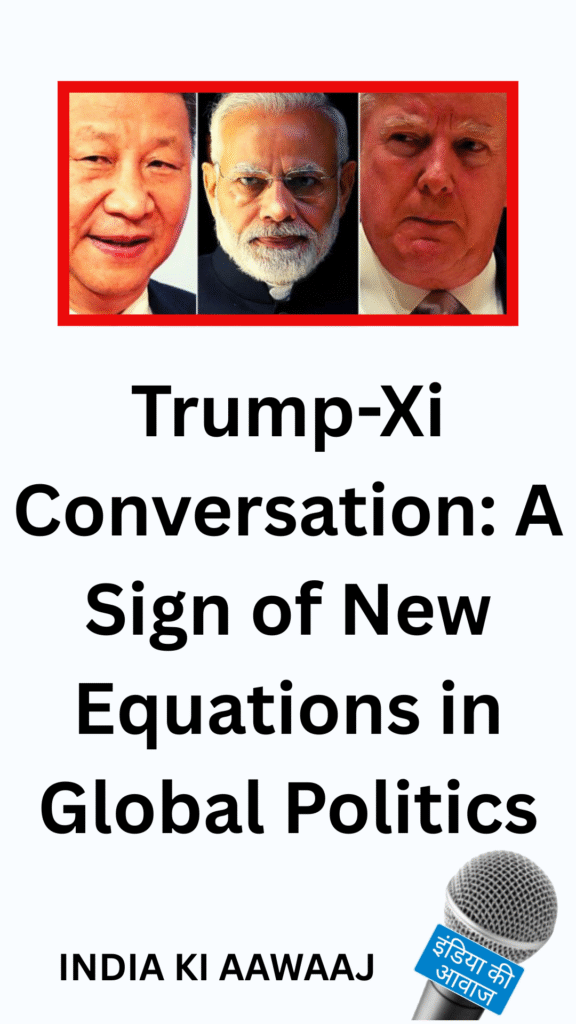
Trump-Xi Conversation: A Sign of New Equations in Global Politics
According to a report in Amar Ujala, former US President Donald Trump and Chinese President Xi Jinping recently held a significant phone conversation. This conversation was not merely a formal interaction between the two leaders, but also foreshadowed future implications for global politics, economic dynamics, and the Indo-Pacific security architecture. According to the report, Xi Jinping also hinted at a possible visit to the US later this year, which is considered crucial in the current geopolitical landscape.
This entire development comes at a time when the world is grappling with several major crises, including trade wars, technological competition, military tensions, and instability in the global economy. In such a scenario, the dialogue between the top leadership of the world’s two largest powers—the US and China—is being seen as a positive initiative.
Geopolitical Significance of the Conversation
Relations between the US and China have experienced continuous ups and downs over the past decade. During Trump’s presidency, trade wars, technology sanctions, and a standoff in the South China Sea widened the distance between the two countries. While Trump and Xi Jinping have held several in-person conversations, bilateral tensions remain deep.
The significance of this new phone conversation is heightened as discussions about Trump’s potential return to power are gaining momentum in the US political landscape. China appears to be attempting to balance its relations with Trump’s policies in advance.
Another important aspect of the talks is Xi Jinping’s potential visit to the US, which could be considered a major step in the diplomatic developments of 2025. This indicates that China wants to prioritize high-level dialogue to stabilize relations with the US.
Bilateral Issues: Trade, Technology, and Investment (a) The Burden of Trade Disputes
In previous years, the US has accused China of unfair trade practices, while China has criticized US tariff policies as detrimental to global trade.
The Trump-Xi talks indicate that both sides may be working toward reducing or redefining trade tensions.
(b) Technological Competition and the AI-5G War
From the Huawei ban to US AI and semiconductor export controls, the two countries are locked in a battle for technological dominance.
The Chinese leadership has recognized that US moves in AI, quantum, 5G, and chip manufacturing directly impact its long-term interests. Therefore, talks with Trump and Xi’s visit to the US could pave the way for a potential compromise in the tech war.
(c) Investment and Global Supply Chains
The pace of US companies moving out of China has increased. China wants to halt this trend.
Strengthening dialogue between the two countries could also have a positive impact on supply chain stability.
Impact on the Asia-Pacific Region
The Indo-Pacific is currently at the center of US-China rivalry. China’s aggressive stance in the South China Sea, the Taiwan issue, and the strategies of US allies like Japan, South Korea, and Australia make this region particularly sensitive.
The Trump-Xi talks could have the following effects:
A reduction in military tensions, if the dialogue remains sustained.
A softening of diplomatic language on the Taiwan issue, although China’s stance is unlikely to change.
The US may also adopt a different approach in the future regarding the strategy of groups like the Quad and AUKUS.
Impact on the Global Economy and Markets
Both economies account for approximately 40% of global GDP. Therefore, any positive dialogue could have direct impacts:
Stabilization of global markets,
Improvement in crude oil and manufacturing,
Increased investor confidence,
And positive pressure on emerging economies.
If Xi visits the US, it could prove to be the biggest diplomatic indicator for economic policies and global markets in 2025.
Trump’s Political Strategy and Electoral Calculations
Trump has always prioritized national security and the “America First” policy to strengthen his political base in the US.
Dialogue with China could send a message to his supporters that he—
is strengthening America’s global role,
is willing to adopt a tough but balanced policy to contain China,
and wants to benefit American industries through trade agreements.
These talks could also serve as a testament to his diplomatic prowess in the upcoming US elections.
China’s Perspective and Xi Jinping’s Strategy
China is currently facing several internal challenges—
economic slowdown,
youth unemployment,
real estate crisis,
and the restructuring of global supply chains.
Under these circumstances, easing tensions with the US is a strategic necessity for China.
Xi Jinping’s potential visit indicates that China—
seeks economic stability,
is trying to improve its global image,
and is seeking to ease US restrictions on its technological and manufacturing capabilities.
Potential Impact on India
The nature of US-China relations is crucial for India.
Strategically, US-China tensions offer India opportunities in the Quad, trade, and defense partnerships.
Economically, if tensions between the two superpowers ease, pressure on India could increase as companies may slow down their China+1 strategy.
Geopolitically, stability in the Indo-Pacific is positive for India.
India must adopt a balanced diplomacy while monitoring these changes.
Conclusion
The phone conversation between Trump and Xi Jinping is not just a routine conversation, but the beginning of new signals in global politics. This conversation could determine the future diplomatic direction—whether it concerns trade wars, technological competition, Asia-Pacific security, or global economic balance.
Xi Jinping’s potential visit to the US will further clarify these signals.
At this critical juncture in world politics, this conversation is a ray of hope that could prove to be a decisive step towards stability and cooperation in US-China relations in the years to come.
Subscribe to the channel for daily updates